
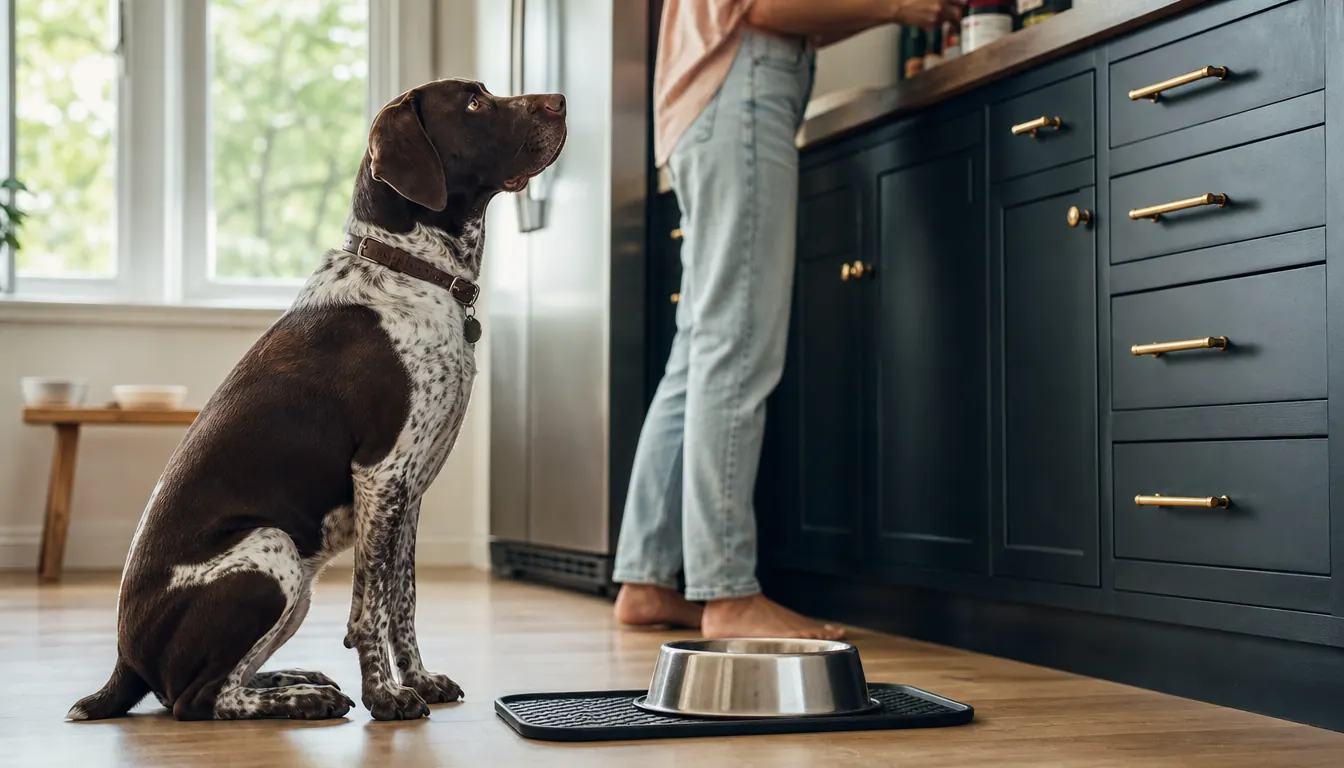
Biscuit is a Beagle mix, eight years old, twenty-seven pounds, and for most of her life she ate the way a Beagle eats, which is to say she was finished before I set the bowl down. Then in the fall of 2025 she started nosing her kibble into a pile on one side of the bowl and walking away from it. She would come back ten minutes later to check whether something better had appeared. Something better did not appear. That is how a topper routine started in this house, and it is why there is now a bottle of oil in my refrigerator door.
A word about who is writing this. I am not a veterinarian, a vet tech or a canine nutritionist. I am sixty-one, retired after twenty-six years cooking in a school cafeteria in Temple, Texas, and I spent most of those years reading district food spec sheets. So I read a pet label the way I used to read a spec sheet: what is in it, how much goes in the bowl, and can I keep doing this on a Tuesday when I am tired. By the time I got to Natural Dog Company salmon oil in February 2026, Biscuit already had a freeze-dried chicken topper at both meals and a warm bone broth at dinner. This was the third thing on her shelf, and I added it on its own, after asking Dr. Patel, because one at a time is the only way I can tell you anything true about what is doing what.
The bottle that lives in my refrigerator door, not on the pantry shelf
Natural Dog Company Wild Alaskan Salmon Oil, sixteen ounces with a pump, is what Biscuit has had over breakfast since February 2026. Check the current price and the label amounts for your dog's weight.
Amazon Check Today's Price on Amazon →What Is Actually in the Bottle
The bottle Natural Dog Company sells is sixteen fluid ounces of liquid salmon and pollock oil, and it comes with a pump in the box. The listing gives the dimensions as 2.5 by 2.5 by 8 inches and the item weight as sixteen ounces. The active ingredients listed are EPA, DHA, omega-3 and omega-6. The form is oil, the flavor is listed as Wild Alaskan Salmon Oil, and the target species is dog. Breed size is listed as small, medium and large, which in practice means the amount that goes in the bowl is set by your dog's weight, not by the size of the bottle.
Under specific uses, the listing names coat, heart, joints and skin. Under product benefits it lists antioxidant, digestive health, heart health, immune support, joint health and skin care. I am reporting that, not prescribing it. I am not qualified to tell you what any of it will do for your dog, and neither is a product page. What I can tell you from my own kitchen is smaller and more boring. It is a liquid that pours, it smells like a fish market, and my dog licks the bowl.
Step 1: Ask your veterinarian before you open the bottle
I asked Dr. Patel at our clinic in Temple before I bought this. I had the listing up on my phone, and I told her what Biscuit was already eating at that point: the same chicken and rice kibble she has had for years, the freeze-dried chicken topper at both meals, and the bone broth at dinner. She said the salmon oil was fine to try at the amount on the label for Biscuit's weight.
The reason I ask about everything, even a bottle of fish oil, is that I am not the one who sees the whole dog. Dr. Patel is. She knew Biscuit's weight from the September checkup and she knew what was already going into the bowl. If I had added this on my own because a listing sounded good, I would have been guessing, and I would have had nobody to ask the first time something changed.
So before you copy anything in this article, have that conversation. Especially if your dog takes medication, has a diagnosed condition, or is already on a food your vet picked out. I am telling you what I saw in my own dog and what a label says. That is the whole of my authority, and it is not a substitute for your vet's.
Step 2: Start below the label amount
Dr. Patel suggested I begin under the amount on the label for a dog Biscuit's weight and work up to it. So I started light and added a little every few days, and I was at the full label amount right around the tenth day. That is my only experience with this bottle, so I cannot tell you what would have happened if I had gone straight to the full amount on the first morning. I did not try it.
What I can tell you is that easing in gave me a week of watching before I committed. If Biscuit had turned her nose up at it, or if her stomach had not agreed with it, I would have found out on a light amount rather than a full one. That seems like plain sense. I do the same with any new food, which is why I have never changed her kibble overnight and would not start now.
There is a practical side to it as well. This is a sixteen ounce bottle, and a dog Biscuit's size is not going to empty it quickly. Going slow that first week costs you almost nothing out of the bottle and buys you a great deal of information.
Step 3: Pump it onto one meal, over the bowl
In this house the oil goes on breakfast only. Dinner already has warm bone broth poured over it, and I did not want two wet toppers landing on the same meal. If something changed, good or bad, I wanted a fair chance of knowing which one it was.
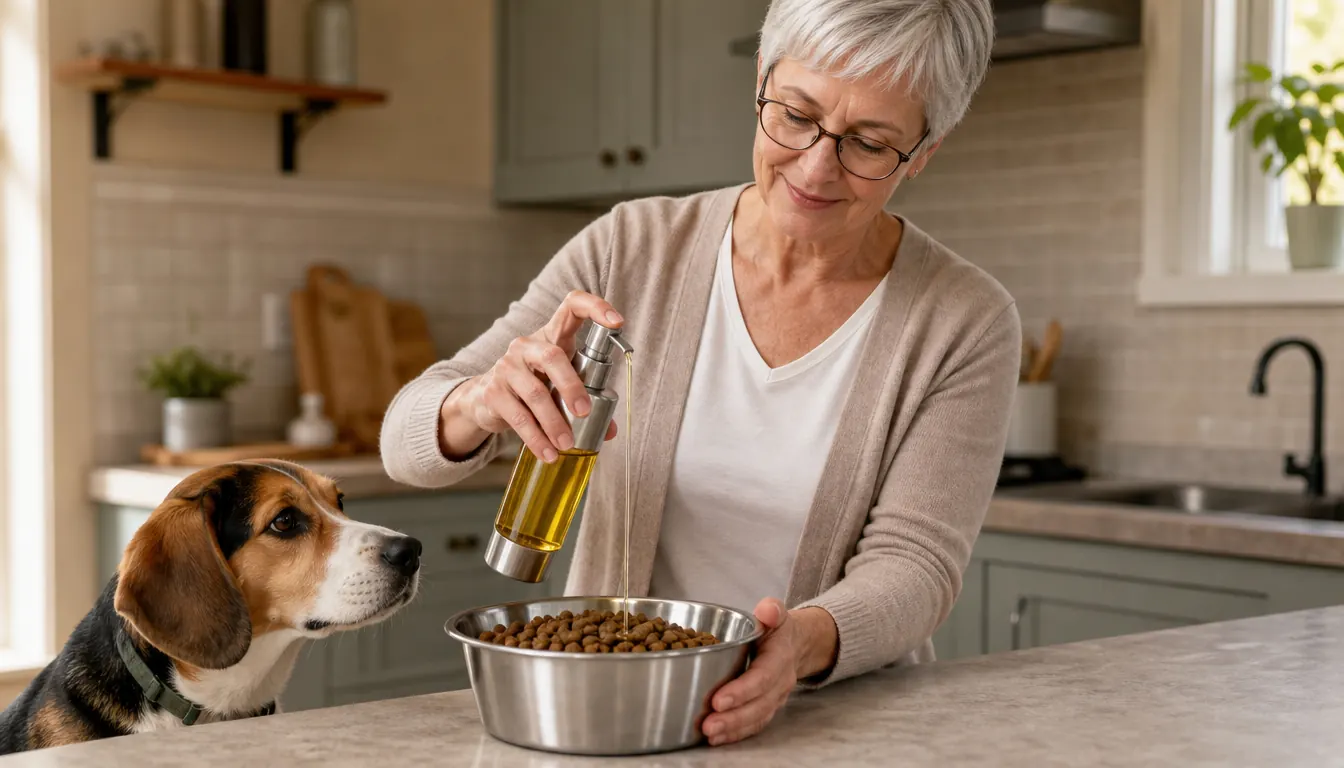
The routine itself is short. I measure her kibble with the one metal scoop, set the bowl down on the rubber mat in the corner by the back door, and pump the label amount straight onto the top of the food. The pump is the push-down kind mounted in the neck of the bottle, so the bottle has to be held upright and over the bowl. My first few attempts had a drip running down the side and landing on the mat, which is not a tragedy, just an annoyance. Hold it over the bowl and it stops happening.
Then I stir it through with a fork so it is not sitting in one wet spot on top. Biscuit would eat it either way. I stir it because I would rather it be spread through the bowl than licked off in the first four seconds.
Step 4: Keep it cold and keep the neck clean
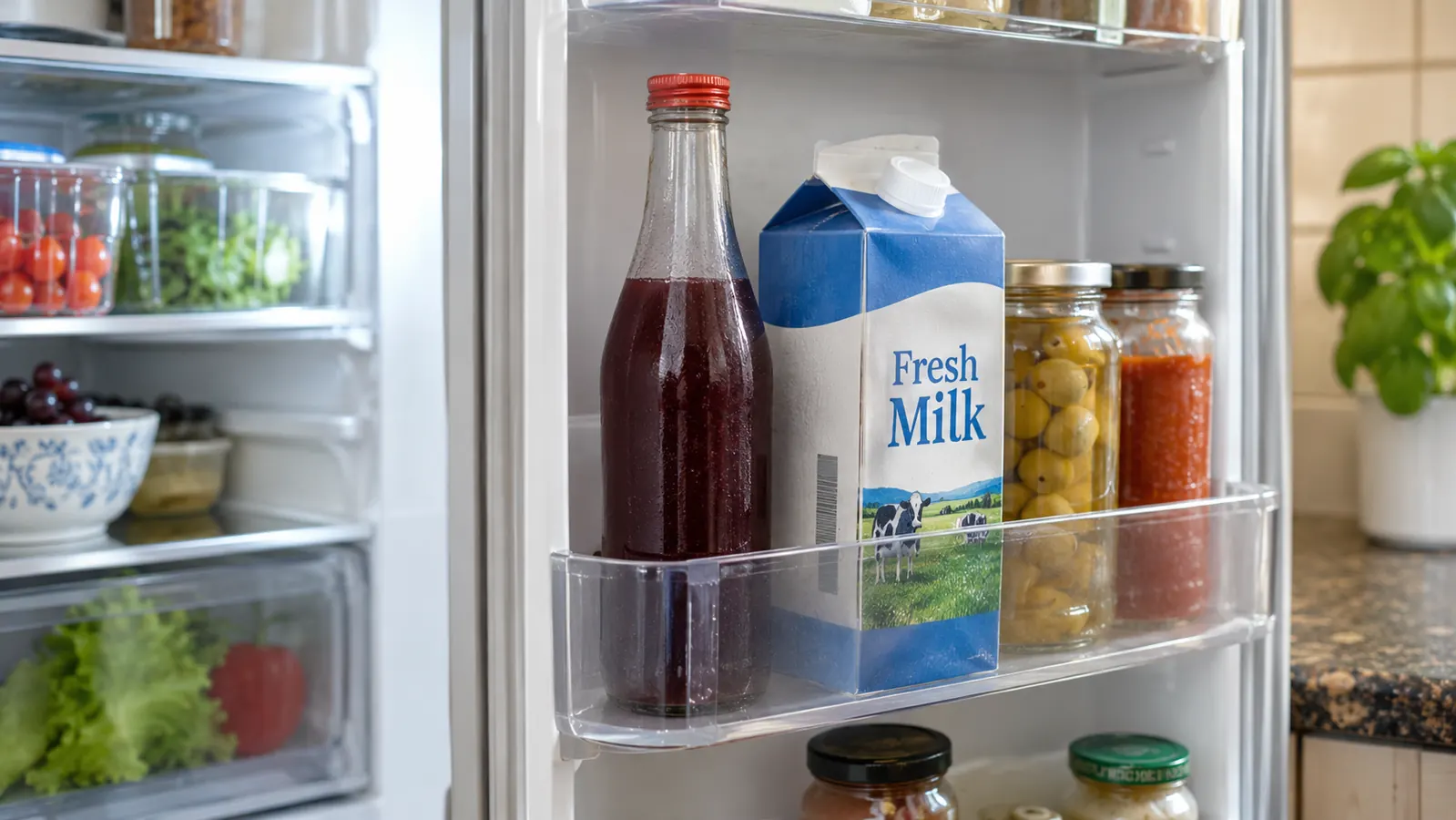
The other things on Biscuit's shelf in the pantry stay at room temperature. This one does not. The bottle lives in the refrigerator door from the day I opened it, and it has stayed there since.
I wipe the neck of the bottle with a paper towel after I feed her, because the pump drips a little and a bottle with dried fish oil on the threads is unpleasant to open the next morning. I wash my hands with soap afterward, the same as I do after handling her freeze-dried topper. Dale walks Biscuit in the evening and will tell anybody who asks that the smell gets on your hands. He is right. If you have opened a can of salmon, it is that smell.
One more thing worth planning for: sixteen ounces takes up real space in a refrigerator door. Mine had room. If yours is crowded with milk and jars, you will be rearranging a shelf on the first day.
Step 5: Watch the bowl, not the calendar
This is the part I would want somebody to tell me. You will not know anything after three days, and if you spend those three days staring at your dog looking for a change, you will imagine one. I pumped and went on with my morning. What I noticed came later, and it was modest. Sometime in the spring, Biscuit was on the porch in the sun and her coat looked shinier to me than I remembered it. That is the size of the claim I am making. I cannot prove the oil did it, and I am not going to pretend I can.
What I can say with more confidence is what did not change. Her stools have stayed regular and boring, which is what you want, and she has never once refused a bowl with oil on it. I also cannot credit this bottle for her cleaning her bowl, because she started doing that back in October, months before this bottle came into the house.
And then there is the arithmetic nobody likes. Oil is calories. When I started putting a topper on every meal, I took a little kibble out of the scoop so the bowl did not grow, and I cut back on the extra treats. Biscuit was thirty pounds at the September 2025 checkup and twenty-seven by June 2026. At that checkup Dr. Patel had said Biscuit was a few pounds heavier than she should be and to watch the treats. The weight came off because I measured the kibble and stopped handing out so many extras, not because of anything in a bottle. I cannot prove which part did what, and I would be lying if I said otherwise.
I cannot prove which bottle did what. What I can tell you is that the routine is short enough that I have kept it up for nine months.
What Else Helps
Three things in this routine matter more than the oil, and none of them cost a thing. The first is the scoop. One metal scoop, level, twice a day, so the bowl is the same size every time. The second is the treats. Biscuit is food motivated with a nose that finds things, and I was handing out far more than I thought I was. The third is patience. I have changed exactly one thing at a time on that shelf and waited weeks between them, which is slow and dull and the only way I can tell you anything true about any of it.
If your dog is a fast eater or a bowl-flipper, a rubber mat under the bowl helps more than you would think. If your dog is bored with plain kibble, a splash of warm water over the top does a surprising amount of work on its own before you buy anything. And if you are changing the food itself and not just adding a topper, do it gradually over a week or more rather than in one day, and ask your vet how they would like you to handle it.
What This Bottle Did Not Do
It did not make my dog younger, and it did not fix the picky eating by itself. Biscuit started cleaning her bowl in October, back when the freeze-dried chicken topper was the new thing on the shelf, and the salmon oil did not arrive until February. It also did not stop her from climbing onto the couch when she knows perfectly well she is not supposed to.
It also smells. I keep waiting to stop noticing and I have not. If you are somebody who cannot stand the smell of fish first thing in the morning, that is a real consideration, and you should hear it from me now rather than find out on the day the box arrives.
Nine months in, the bottle is still in the door
Natural Dog Company Wild Alaskan Salmon Oil, sixteen ounces with a pump, is the one thing on Biscuit's shelf that goes over breakfast and nothing else. Check the current price, read the label amounts for your dog's weight, then ask your vet before you start.
Amazon See It on Amazon →